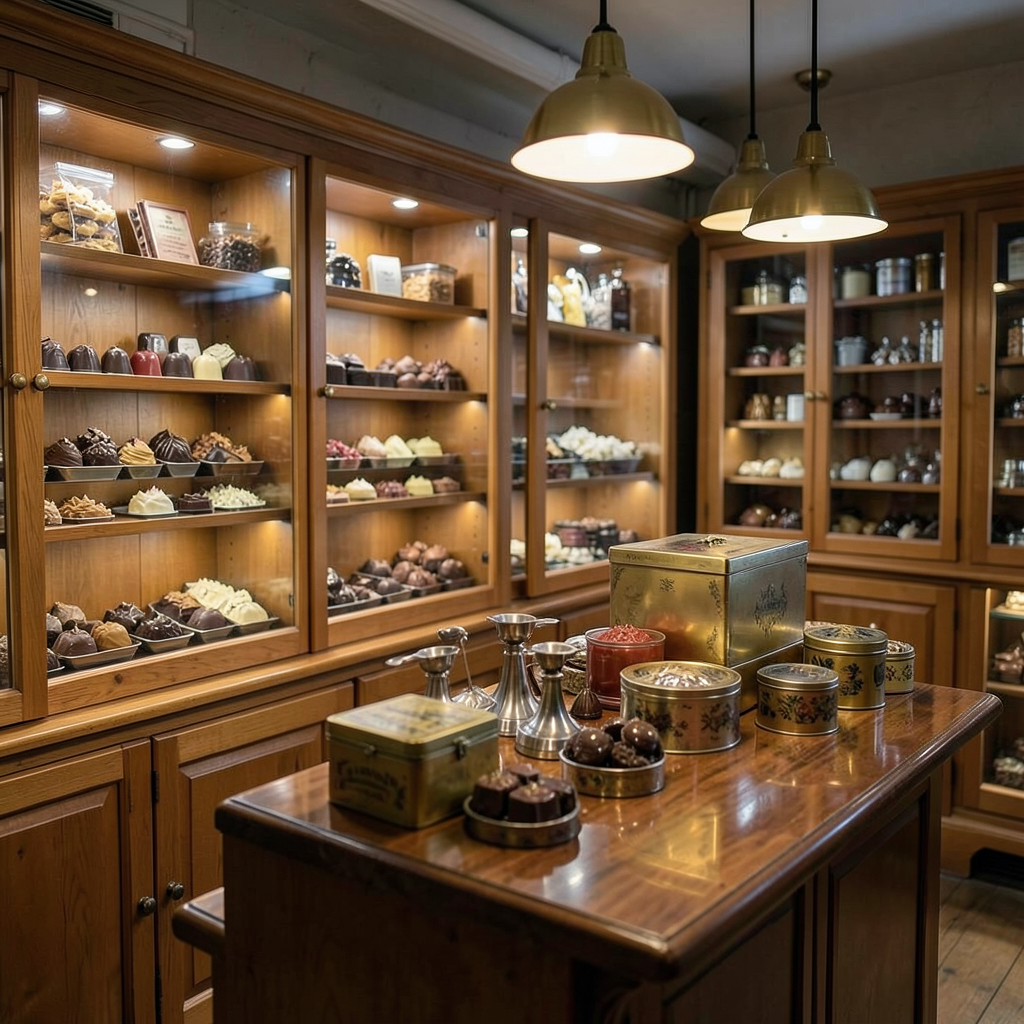

A confectionery enterprise created by Jewish refugees operated for fifty years from a north London basement, producing handcrafted chocolates that eventually achieved royal recognition.
Ackermans Chocolates functioned from premises on Goldhurst Terrace and was founded by Werner and Lotte Ackerman.
Trading ceased approximately two decades ago after half a century in operation.
In Berlin during the years before the Second World War, Werner worked as a legal professional while Lotte had received training as a musician specialising in piano.
The establishment of Nazi authority during the 1930s rendered their continued residence in Germany untenable.
Lotte’s family ties to the Kempinski business proved instrumental in facilitating their departure.
The Kempinski name was synonymous with Berlin’s hospitality sector, operating an extensive network of catering establishments and wine venues across the city.
Co-proprietor Hans Kempinski had been investigating international escape options as political conditions deteriorated, and in 1935 secured Home Office authorization to launch a German dining establishment on Swallow Street in Piccadilly.
This enterprise provided the mechanism for transferring personnel from Germany to Britain, encompassing his son Gerhard and his spouse Mela.
The Ackermans similarly secured positions at the London venue, thereby obtaining the means to flee.
Lotte acquired her confectionery expertise at Kempinski’s Berlin locations, which stood her in good stead when the enterprise expanded to the capital.
Their recruitment was conditional upon demonstrating competence in hospitality.
Between April 1935 and their relocation to Britain, both Lotte and Werner—who until then possessed only elementary cooking abilities—spent twelve months mastering their craft in the Kempinski kitchens situated on Kurfürstendamm.
Lotte specialized in producing after-dinner chocolates and small pastries, while Werner acquired proficiency in Baumkuchen preparation.
They relocated to accommodation in Hampstead during 1936, residing in proximity to the Kempinski family.
Lotte took up her position at the London restaurant while Werner commenced Baumkuchen production at their residence using equipment transported from Germany.
The reduced gas pressure prevalent in British households affected the moisture content of his output, and discerning customers showed little interest in such a premium-priced commodity.
When hostilities commenced in 1940, Werner found himself detained on the Isle of Man following his classification as a hostile foreigner.
His liberty was restored only after his enlistment in the Pioneer Corps.
During his military secondment, Lotte established an auxiliary chocolate-making enterprise.
Despite the imposition of rationing on both sugar and cocoa across Britain, she secured supplies through Max Weldon, a fellow displaced person involved in the cocoa sector with industry connections to the Caxton firm, which concentrated on industrial-grade chocolate.
Lotte initiated production from her domestic kitchen with assistance from other refugee women, distributing the completed items throughout their social circle.
Following Werner’s discharge in August 1945, the couple dedicated themselves entirely to confectionery production, exploiting the market void for continental-style dark chocolate products.
A helper supported Lotte in a room situated in Fairfax Mews near Finchley Road, enabling full-time manufacturing, while Werner attended to customers.
The inaugural permanent retail outlet launched in 1952 on Kensington Church Street, coinciding conveniently with the subsequent year’s termination of chocolate rationing.
Werner crafted an attention-grabbing storefront that appealed to sophisticated buyers, and in 1956 a second establishment commenced operations at nine Goldhurst Terrace, with manufacturing relocated to the basement level.
The enterprise distinguished itself through its emphasis on dark chocolate—contrary to British preference for milk varieties—and continental offerings such as marzipan.
This positioning attracted a prestigious customer base and brought the business to royal attention.
Princess Alexandra, a member of the royal household residing in Kensington Palace, became the initial royal patron, frequently visiting the Kensington location in person.
Subsequently, Princess Margaret and the Queen Mother became frequent purchasers.
Hand-packed chocolate selections were delivered upon request to both Kensington Palace and Clarence House, culminating in the awarding of a Royal Warrant in 1968.
Packaging could then bear the royal crest and designation as Confectioners by Appointment to HM Queen Elizabeth the Queen Mother.
During seasonal peaks, substantial queues developed outside the Goldhurst Terrace location, which evolved into a focal point for the émigré population.
Lotte demonstrated exceptional skill as a chocolatier, possessing the expertise to produce the characteristic glossy finish and rich flavour that distinguishes superior chocolate.
Werner, who took pleasure in customer interactions, lacked ability in wrapping duties and wisely recruited a team of displaced persons to operate the counter.
By 1978, their health had deteriorated with both founders experiencing cardiac problems despite continuing into their seventies, prompting them to exit the business.
They transferred ownership to a young Swiss pastry chef named Werner Krattiger, whom they had mentored as an apprentice.
Krattiger pursued growth while maintaining the Goldhurst Terrace presence, relocating manufacturing to premises on an industrial estate within Camden.
Output expanded to four thousand kilograms weekly, representing a substantial increase from the approximately one hundred kilograms previously produced by Lotte and her collaborators.
Tragically, Krattiger contracted Aids and passed away in 1992 at the age of forty-two.
His will established a foundation to sustain Ackermans Chocolates, directing a portion of earnings toward Aids research.
The company established relationships with overseas distributors, temporarily achieving distribution through KaDeWe in Berlin, frequently termed the Harrods of Germany.
In 1996, the future monarch King Charles toured the refurbished Food Hall at Selfridges, where Ackermans maintained a concession.
This exposure led to an arrangement to supply his Duchy Originals range with their distinctive mint thins, a confection developed by Lotte and regarded as her most significant contribution to the British confectionery sector.
During the late 1990s, Charbonnel et Walker acquired a controlling interest in the enterprise, maintaining the Ackermans identity for a period.
Following the Queen Mother’s passing in 2002, the Royal Warrant lapsed, and the brand along with the Goldhurst Terrace establishment ceased to exist.
Family members preserved the original shop signage, which now occupies a prominent position in a relative’s kitchen, commemorating the founders and their considerable accomplishments.