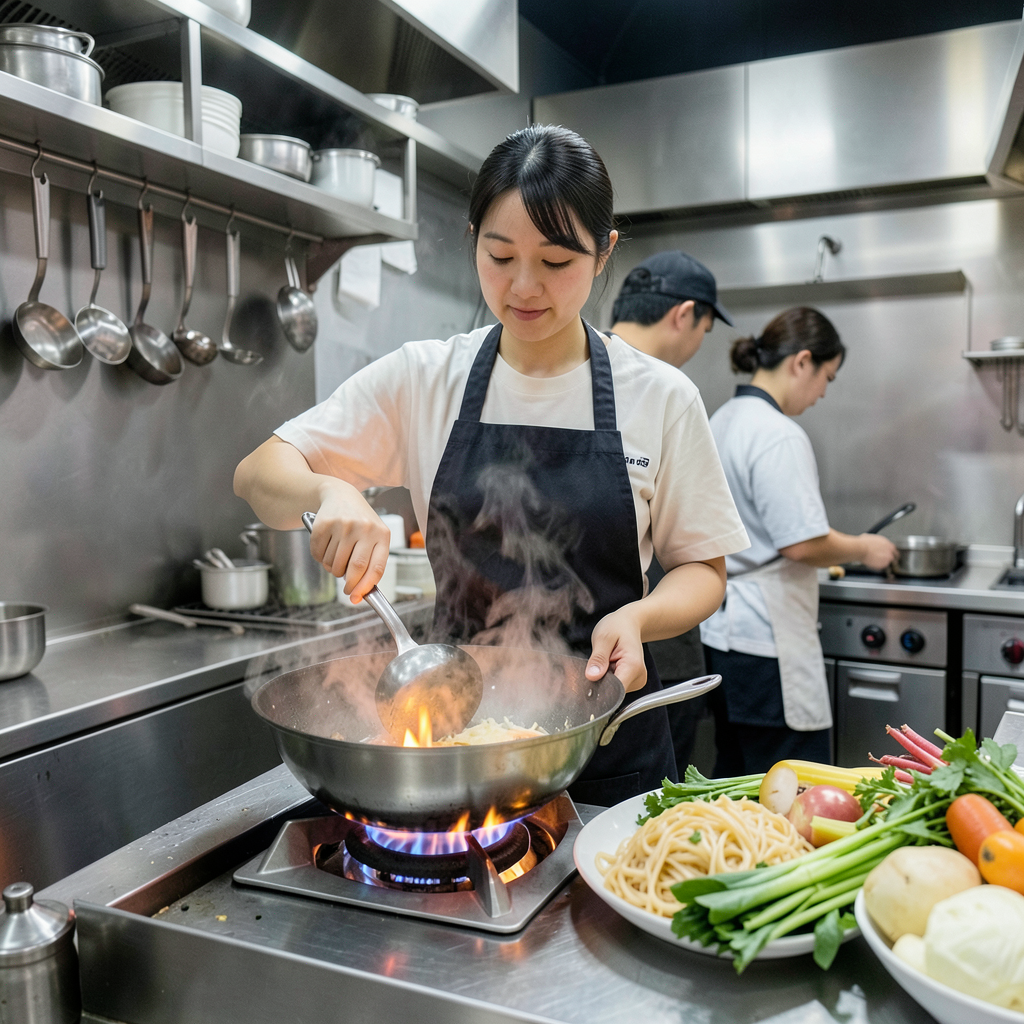

The pan-Asian restaurant chain wagamama operates more than 160 locations throughout the United Kingdom, having originally been established in 1992.
A recent behind-the-scenes experience at one of the brand’s establishments offered insight into the operational methods employed in preparing signature dishes.
The visit took place at the Great Marlborough Street branch in London.
Participants were invited to cook two menu items under the guidance of Steve Mangleshot, the company’s Global Executive Chef and Brand Ambassador.
The session was conducted in a development kitchen area situated on an upper level of the restaurant.
Alongside two additional participants, the team prepared Teppanyaki and Firecracker Chicken during the cooking class.
Prior to commencing food preparation, Chef Mangleshot provided an overview of the techniques involved and discussed elements of his career within the restaurant industry and with the chain.
An observation shared during the session noted that the brand maintains a presence across multiple countries and enjoys particular popularity in Italy.
Participants were outfitted with standard chef attire before entering the kitchen space, which was divided into two distinct cooking areas.
One section featured a large wok station, while the other was equipped with induction cooking equipment.
The Teppanyaki was prepared at the induction hob area.
Ingredients for each dish were laid out in advance, with preparation having been completed prior to cooking.
The Teppanyaki process involved adding a modest amount of oil to the cooking surface, followed by the noodles.
After approximately one minute of stirring, egg was incorporated and mixed thoroughly throughout the noodles.
A soy-based seasoning was then added, before vegetables including peppers and bean sprouts were introduced, along with chicken and prawns.
Continuous stirring was maintained throughout, and the dish was subsequently plated with the food positioned centrally on the plate.
Chef Mangleshot supervised the plating process, advising on presentation technique.
The final touches included sesame seeds, pickled ginger, and fried onions.
The cooking time for the demonstration session lasted approximately five minutes.
However, it was explained that in the actual restaurant kitchen, the same dish would typically be completed in approximately two minutes or less.
The high level of pre-preparation allows for this rapid final cooking stage.
The operational target set by the brand is to serve dishes within five minutes of receiving a customer’s order.
Following plating, the Teppanyaki was sampled.
The dish featured pronounced umami characteristics, delivering a savoury flavour profile.
The second dish, Firecracker Chicken, was prepared at the wok station.
Oil was heated in the wok before peppers and onions were added and stir-fried until caramelisation occurred.
Chicken pieces were then incorporated, followed by application of the firecracker sauce.
The ingredients were mixed over heat for several minutes.
Plating was straightforward, with any sauce splatters around the plate’s edge being easily cleaned.
A well was created in the centre of the plated food, into which a bowl of rice was placed.
The plate was then lifted to form a dome shape over the rice.
Garnishes consisting of sesame seeds and lime were applied to complete the dish.
The firecracker sauce provides a distinctive flavour without dominating the other elements of the dish, offering a unique taste profile while remaining accessible to those who typically avoid spicy options.
The experience demonstrated that wagamama places emphasis on using fresh ingredients to produce balanced meals.
The rapid preparation methods, with dishes often completed within one to two minutes, are achieved through thorough advance preparation.
The goal of delivering food within five minutes of ordering illustrates the operational efficiency maintained in the kitchen environment.