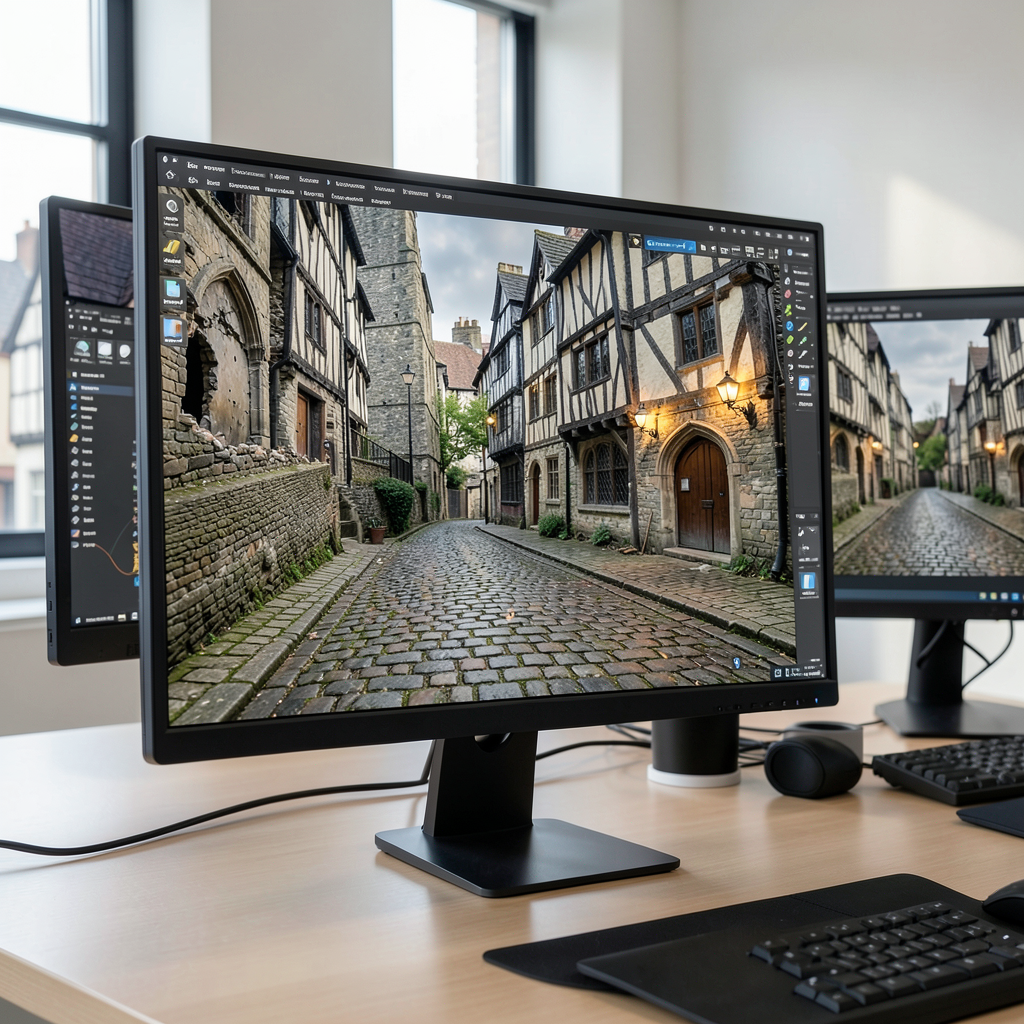

A resident of the capital with a deep interest in vanished urban structures has employed artificial intelligence to digitally resurrect demolished medieval thoroughfares.
Daniel Coughlin operates the YouTube platform titled The Curious Compendium of Architectural What-Ifs, documenting the capital’s evolving urban fabric across periods of demolition and reconstruction.
Through the application of AI-generated imagery alongside historical cartography and archival photography, vanished structures are digitally rebuilt and visualised within contemporary streetscapes.
One particular presentation traces the subterranean Fleet River from its origins on Hampstead Heath to its confluence with the Thames.
Another focuses on reconstructing the localities of Wych Street and Holywell Street situated between Covent Garden and the Aldwych district.
Mr Coughlin, educated at schools in the Parliament Hill area and raised in West Hampstead, reconstructs the remarkable historic medieval lanes that once connected the Strand to Drury Lane before their eradication during the Aldwych redevelopment scheme of the early twentieth century.
The project emerges from a passion for counterfactual urban history, presenting hypothetical scenarios grounded in authentic topography, architecture and documented events.
Mr Coughlin’s connection to the locality stems from his grandfather Jeremiah Coughlin, who entered the world in 1894 in the impoverished locality of Little Wild Court situated off Little Wild Street.
Jeremiah subsequently occupied the position of station master at Covent Garden Underground station, where he reportedly encountered the spectral presence of Victorian performer William Terriss, an encounter that profoundly disturbed him.
The spectral figure, consistently described as a tall individual dressed in formal attire including a top hat, opera cloak and gloves, is believed by some to represent the performer who met a violent end at the entrance to the Adelphi Theatre on the Strand in 1897.
This intriguing detail connects directly to the area examined in the presentation, a district obliterated between 1901 and 1905 by London County Council as a component of the broader Aldwych and Kingsway construction initiative.
Within the presentation, Mr Coughlin describes how this concentrated network of ancient courts, passages and hostelries was eliminated when Edwardian municipal authorities sought to carve a wide avenue through one of central London’s most densely populated and deteriorated quarters.
For those responsible, the operation represented urban improvement: clearing substandard housing and reducing traffic bottlenecks, though it necessitated the removal of narrow medieval passages containing establishments such as taverns and booksellers, alongside timber-framed structures from the Jacobean period that had endured the catastrophic blaze of 1666.
Holywell Street had acquired notoriety as a venue for booksellers dealing in controversial publications, subsequently expanding into trade in adult literature, while Wych Street functioned as an ancient passage extending from the vicinity of St Clement Danes toward Drury Lane.
Mr Coughlin poses the question of what might have transpired had the redevelopment scheme never materialised, suggesting the possibility that such a weathered Jacobean neighbourhood might eventually have undergone restoration to become among the capital’s most evocative heritage quarters.
The visual reconstruction encompasses establishments including the Rising Sun establishment situated in Wych Street, alongside the New Inn and the Vere Street locale, now portrayed as a contemporary quarter featuring specialist food producers and espresso venues.