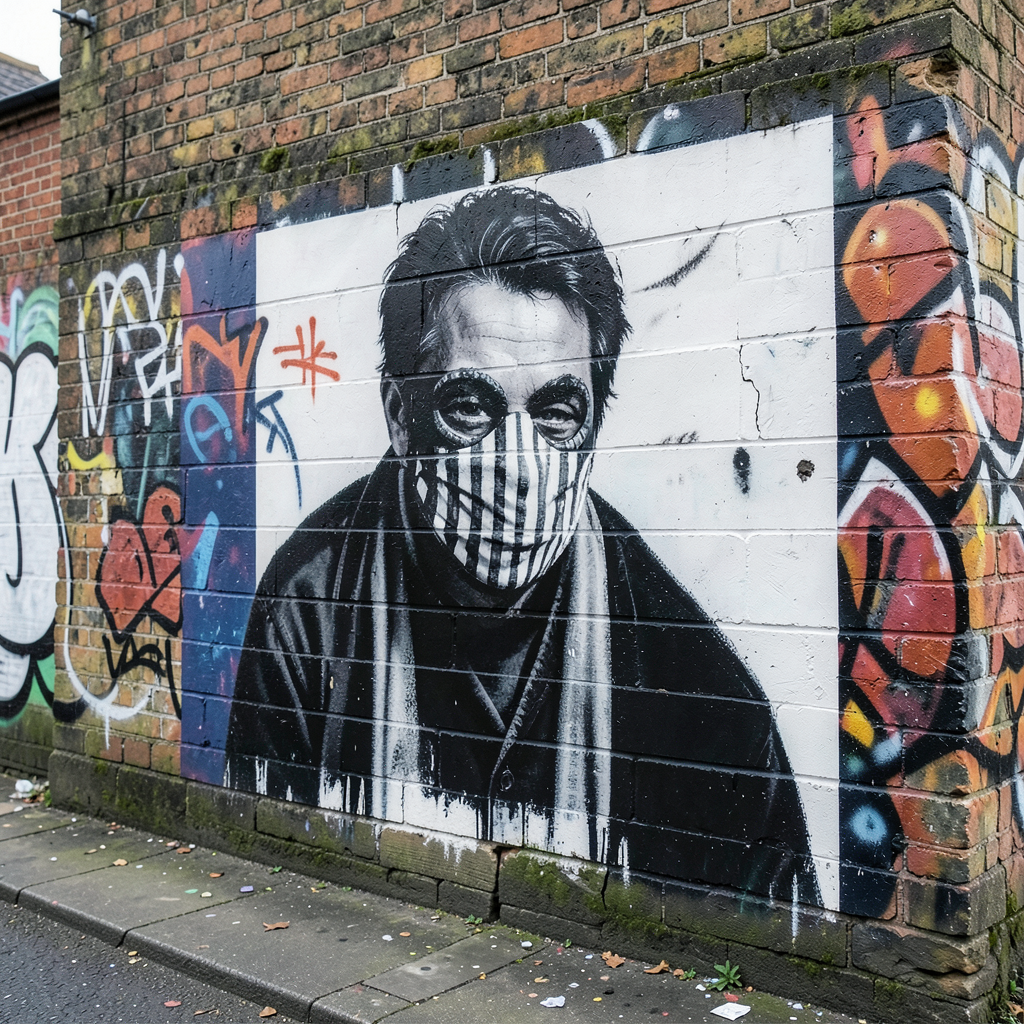

The real name behind the famous British street artist Banksy appears to have been uncovered after years of conjecture.
The secretive figure has achieved worldwide fame for his urban artwork, appearing across Britain and abroad in locations such as Ukraine and the separation barrier in the West Bank.
Among the artist’s best-known pieces are:
Balloon Girl
Kissing Coppers
Flower Thrower
Love is in the Bin
Pulp Fiction
Show Me the Monet
Since emerging in public view during the late 1990s, the creator has managed to stay unidentified.
A recent examination by Reuters is said to be the initial investigation to conclusively determine who the enigmatic figure is.
Who is Banksy?
As reported by Reuters, the individual is Robin Gunningham, a 51-year-old resident of Bristol.
A handwritten note written 26 years ago reportedly provided the final clue that exposed the artist’s identity.
The Telegraph reports that Reuters found that in 2000, Banksy was in New York during Fashion Week, and a Marc Jacobs clothing promotion had been positioned on top of a brownstone building, featuring the words Boys Love Marc Jacobs.
Those familiar with Banksy who spoke to Reuters explained that the creator became intrigued by the advertisement and climbed the structure to alter it.
Steve Lazarides, who previously managed and photographed the artist, described how the individual altered the Marc Jacobs Men’s advertisement by adding ridiculous teeth to the model.
Before finishing the modifications, however, New York authorities arrested the creator and charged him with a minor criminal offence.
The creator was also ordered to pay a sum of US$310 (approximately £247).
According to The Telegraph, the inquiry discovered that official law enforcement and judicial documents from this 2000 arrest were located, showing the name Robin Gunningham.
Banksy’s legal representatives insist his identity stays concealed
Even though the Reuters examination claims to possess evidence of Banksy’s identity, the artist’s lawyers dispute these findings and maintain he remains anonymous.
Banksy’s attorney, Mark Stephens, told Reuters that his client does not confirm the accuracy of many details in their inquiry, adding this mattered because the creator had faced obsessive, threatening and extremist behaviour.
Mr Stephens also commented that working anonymously or under a pseudonym fulfills important social purposes, protecting free expression by allowing creators to question power without worrying about retaliation, suppression or mistreatment, especially when addressing sensitive subjects such as politics, religion or human rights.